Friday, June 9, 2017

Matsumoto

True colors!
With no train service, we're back on the bus for our next destination, the town of Matsumoto in central Honshu (the main island of Japan).  It's about a 90 minute ride from Hirayu Onsen.  As we travel down from the mountains, we're treated to scenic lakes and blooming cherry trees.

Now I feel like I'm back in New Zealand.


Bonus cherry blooms in the foothills - they've already finished in Tokyo.


Steve thinks he'll be able to do this in our yard when we get home.

We enter the outskirts of Matsumoto and I'm charmed by the small houses with beautifully landscaped yards - it looks like they have giant bonsai trees!  THIS is what I was expecting it to be like in Kyoto - I'm glad I've finally found the location of the pretty city I pictured.  Here are some quick shots as the bus drives through town.


And they ALL look like this!  I wonder if it's a city ordinance.

Castle selfie!
Our first stop is the most well known landmark, Matsumoto Castle. (I had been bemoaning the fact that most Japanese and European castles are named after people and places, and not given fun, unique names like in Game of Thrones.  However, while researching this post, I discovered that it does have the nickname "Crow Castle" because of the black exterior and wing shaped roof line.  There's nothing at the site to indicate that, though.)  It's considered one of Japan's original castles, and was built in the 16th century.  It still contains the original wooden interiors and external stonework.  I'm assuming termites are not a problem in Japan!  We're able to walk around (barefoot - you're required to take off your shoes) while it's relatively uncrowded (more on that later).  

People waiting to enter.


Like all Japanese castles, it's basically empty inside (there are some displays and descriptions of weapons currently here).  During the earlier time periods they didn't use heavy furniture or statues to decorate - mostly they slept on futons that would be rolled up and put away in the daytime.  Instead of chairs they sat on the floor at low tables.  Art works consisted of wall hangings, flower arrangements, written poems or items of every day use made very well, like painted screens.  It helped with the defense of the castle, because samurai could move around the floors very easily.  


The castle is six stories, though it only appears like five on the outside because they didn't put windows on one floor (to confuse attackers and to use as a storage area).  The stairs are very narrow and steep - similar to what you would find on a boat.  Windows face in all four directions, and from the top floor you have a 360 degree view of the surrounding countryside.  The castle also has defensive features, like arrow slits and special chutes that allowed the defenders to drop rocks or boiling water on people below.  And of course, there's a moat!
What moon?

The last part we see is the moon viewing room, built around 1635.  I don't know how effective it was, because it has a roof with an overhang, so you can't see much of the sky at a time.  The large windows do make a nice frame for pictures of the exterior garden.

We happen to arrive as they are getting ready to do a demonstration of antique guns.  We sit for awhile, waiting for it to start.  The "samurai" march out, and then speeches are made - all in Japanese (of course).  We decide we're bored, and go ahead and enter the castle.  It does help to keep the crowds outside, so we don't have to wait too long to climb some of the stairs.  While we're exploring we hear some gunshots, and we're able to peek out at some of the shooting.  I'm kind of glad we're actually inside the castle - some of the viewers are sitting close to the targets! 

The black lines in the grass is the footprint of another building that used to be on the grounds.

I hope it's not still loaded!


After we exit, the samurai are posing for pictures with the visitors.  Steve jumps right in with no hesitation!


"These are the voyages of the starship Azalea..."


As we walk around the gardens and surrounding area, we come across this little azalea bush.  The sign is in English and Japanese, so we're able to learn that the plant is being grown from seeds that have traveled to outer space.  Cool!  Maybe I'll be able to go in outer space one day, too.


One last photo, complete with castle, bridge and flowers.

Our hotel is close enough that we can walk back from the castle (and do a little souvenir shopping, too).  Earlier we'd dropped off our bags, but we couldn't check in at the time.  We're able to do so now, then Steve finds a pizza place, Pizza Verde Matsumoto, for us to have dinner.  Later we both have a shiatsu massage.  Why can't we ever seem to find shiatsu in Tokyo?

So pretty!
The next morning we're off to see a little bit more of the city.  I love the manhole covers here.  They're covered with pictures of temari, a Japanese thread ball.  I've seen them for sale (they always make me think of Christmas ornaments) and I've purchased a kit to make one, but I haven't done it yet.  Now maybe I'm inspired...

Starting in the 1980s municipalities were allowed to design their own manhole covers, and it became a bit of a competition between them to see who could create the best design.  There's over 6000 different ones in Japan 
                                                                     and there's even a Japan Society of Manhole Covers.

Will this frog keep you safe or attack you?
There's a shopping area here named Nakamachi Street that's lined with old merchant houses that have been turned into stores.  The area also has many frog statues!  Luckily, one place has a sign, in English, to explain it.  A shrine was built here in 1879 and the river bank became an entrance to the shrine.  Because horse carriages were not allowed along the river bank, the shrine began to promote events and entertainment there to encourage visitors.  Naturally, people also began businesses along the river bank, due to the increased crowds.  Since no vehicles were allowed, the shop owners said the street is a place where you can come, buy and go home safely (in Japanese - kaeru).  The word frog is also kaeru in Japanese, so visitors started calling it Frog St.  Business owners began putting up frog statues to watch over everyone and keep them safe.


One of the shops along the street

Water fountains are also very common along the sidewalk.  The city brags about how fresh and clean tasting the liquid is, and many businesses have unique displays to provide people with free drinking water.  Steve makes sure to try them all!

I'd give this a 9 on a scale of 1-10.

Hmmm...I think I detect a hint of asparagus.


After a little bit of shopping (Tie-Dye may have gotten a stuffed frog toy) we're ready to head back home.  We're grateful to be back in "civilization," and have no problems hailing a taxi, stopping at a 7-11 for a drink and catching our train for the 2 1/2 hour ride back to Tokyo.

The frog's thoughts, " Why is this guy touching me?!?"

Monday, June 5, 2017

Japanese Alps

The magnificent Japanese Alps!

We decide to run off for a long weekend to explore the central part of the country, the Japanese Alps.  The area encompasses several mountain ranges, and we stay in the Hida Mountains, which are over 10,000 feet high.  

Leaving Tokyo on the bus!
It's not easy to get there without a car (and some parts don't even open to traffic until mid-April).  Google gives us directions with three train transfers and then a bus, but I have the concierge call the hotel to see if there's a better way.  It turns out from Tokyo there's a bus that goes directly from Shinjuku Station to the Hirayu Onsen (town? stop? village?  I never find out exactly what area the name refers to.)  The only way I can make it appear on Google is if I specifically use Shinjuku Station as my departure point.  Even though it's a 4.5 hour bus trip, it's shorter than the multi-train & bus route that Google gave me previously, so I buy a ticket.

Steve has work in Osaka, so he's taking his own train and bus ride so we can meet up at the hotel.  Even though he's a lot closer to the resort town (as the crow flies), his trip takes an hour longer.  

How to make a 4.5 hour bus trim more fun!
(FYI - that's only a 6 oz bottle!)
I'm unsure about the lengthy bus route, because I've gotten used to riding trains, which allow you to get up and walk around.  They also have good size seats, large bathrooms, vending machines, and sometimes employees selling snacks and drinks.  I figure the bus will at least have a bathroom, and it does, but my misgivings about the seats turn out to be correct - they are very narrow.  Luckily, no one is beside me on the bus, so I'm pretty comfortable.  I also come prepared with snacks and goodies!  It turns out we take a 10 minute stop at a rest area every 90 minutes, so I never have to find out what condition the bus bathroom is in.


Am I on a bus or a DeLorean?


Riding into the mountains is like going back in time!  Sakura season is finished in Tokyo, but as we go into the higher elevations, I start seeing cherry trees in full bloom...and when we arrive in Hirayu, the trees haven't even begun blooming.


our private onsen and deck

We spend a couple of nights at Miyama Ouan, a ryokan (traditional Japanese inn).  We book a room with our own private open air onsen (hot spring pool).  At our location the temperature has a high in the mid-40s and a low around 30, so the naturally heated mineral water feels wonderful.  There's a paper in the room listing all the "nutrients" that can be found in the springs, but it's in Japanese.  Luckily chemical symbols are universal, so we can figure out some of the minerals in there. 

Double decker bus gondala


Naturally, we want to be up close and personal to the mountains!  We have some nice views from our hotel and room, but we take (another) 30-minute bus ride and arrive at the Shin-hotaka Ropeway.  This double decker gondala takes you up over 3000 feet so you can be closer to the peaks.   It's faster than mountain climbing!  The entire site consists of two different ropeways to take you to the top, several restaurants, viewing platforms, and (of course) gift shops.


Japan?  Switzerland? Where am I?
We're lucky to have a clear day while we're there!  It's below freezing at the platform, at about 7000 ft.  There's less snow in one direction - I'm going to assume those mountain sides face south, but if you know how I am with directions you know not to trust me when I use words like north, west, etc. (or left turn, right turn...).  We're completely surrounded by peaks, and the ranges continue off into the distance.  It's breathtaking.  I wish I could take a 360 degree panorama. 

If the sides face south, does that mean I'm looking north?  Help!  I'm so confused.

If that mountain peak is 3000 feet higher than where we are, Steve must be pretty tall!


My turn with the mountain!


You knew a selfie was coming!

I miss my toys (sob)!


I think Steve misses his yard toys at home...he's ready to take the snow blower out for a spin! 


Back at the Hirayu Onsen bus station, I take a quick stroll around to see what's there.  It's similar to a large convenience store, with snacks, drinks and a few fresh items, but there's also large public bathrooms, places to sit, and a gift shop.  Japanese people often bring gifts home to the coworkers and neighbors when they travel, and it's very common to see a Japanese person walking to the cashier while holding 15 boxes of local specialties.  The boxes are always nicely wrapped and sometimes have accompanying gift bags.  We decide to try out the Hida Milk Cheese Roll.  It's kind of like a baked sponge cake rolled up with a cream cheese like filling (it didn't taste really cheesy - in fact, it was kind of bland.  If you added some jam or fruit in syrup to it, it would probably taste very good).

Not a gift - it's for us!


the cheese roll


I skipped the Kit Kat sake!


I see a few new things as I wander around.  Did you know Kit Kat makes sake?  Nope, me neither.


There's some different flavors of Kit Kat candy, too. This is the first time I've noticed apple or red bean sandwich flavors.

I skipped these, too!


You know what we don't see - an ATM!  I thought for sure there would be one here, but there isn't.  Google shows one at the post office (which is across the street) and they tell Steve there are no ATMs in town.  It's the same at the Ropeway, and that's a major tourist attraction (and they only accept cash - it's $30/person to ride roundtrip).  The Hirayu Onsen area is small, but it's not tiny - there's multiple hotels, restaurants, hot spring resorts, along with residences, but it's the first place I've been to in Japan with no trains, taxis, banks, ATM machines or convenience stores (7-11, etc).  I would classify this as rural!

We walk five minutes from the bus station to return to our hotel and quickly change into our provided yukatas.  One of the best parts about staying in a ryokan is getting to walk around everywhere in the light cotton kimonos, even to dinner!  We're also provided with a noragi, a traditional fisherman's jacket.  To reach the restaurant we have to walk along one hallway between two buildings, and it's not heated, so we need it! 

Steve's happy to grill again!
We have a multi course dinner, though the highlight is the main entree - cooking our food on the in-table grill.  The Hida area is known for it's dairy and beef, and we're able to enjoy both while staying at Miyama Ouan.

Cute dessert selection.  The treat on the far left is
wrapped in an (edible) cherry tree leaf.


Complementary Hida milk and coffee milk are provided from 3:00pm - 10:00pm.  It's meant to be drunk after you soak in the onsen.  We never have the rational explained to us.  I don't think the Japanese people feel that milk is part of breakfast.  (Side note:  I just saw an article from NBC News that recommends re-hydrating with milk after exercise.  A study in Canada found that it was superior to sports drinks or water for young children, because of the proteins, sugars and carbohydrates that are in milk.  Maybe our ryokan is on to something!)

Despite what the sign says I still
filch one for our room to mix with my
coffee in the morning.
Milk - it does a body good!


This resort serves a full Japanese breakfast in the morning.  We had similar items when we stayed at the B&B in Miyakajima, but many times at hotels like this they also offer a Western breakfast.  We try the different things, but it's really not to our taste.  And they only serve tea!  The following morning I'm prepared, and stop in the lounge to bring the complementary coffee with me.  I'm safe to do it - it's not against the rules!

My breakfast.  I'm glad I don't have to do the dishes!
Steve doesn't look very excited about his breakfast.


There's a 210 ft high waterfall nearby, Hirayu Otori.  We hike the 1.5 miles to reach it, though most of the time we're walking through the town.  It's near a ski resort that's closed down for the warmer months and the pathway to the foot of the falls hasn't been opened for the summer.  We're only allowed to go to the edge of the birch forest, but it still makes a pretty picture in the distance.  We're able to follow along the Otakigawa (I think that's it's name) waterway, which the Hirayu Otari flows into.

I should have made him strike a pose.
No one fell in taking this picture!  Another win!


Did you predict this selfie, too?

Friday, June 2, 2017

Kindle Reading

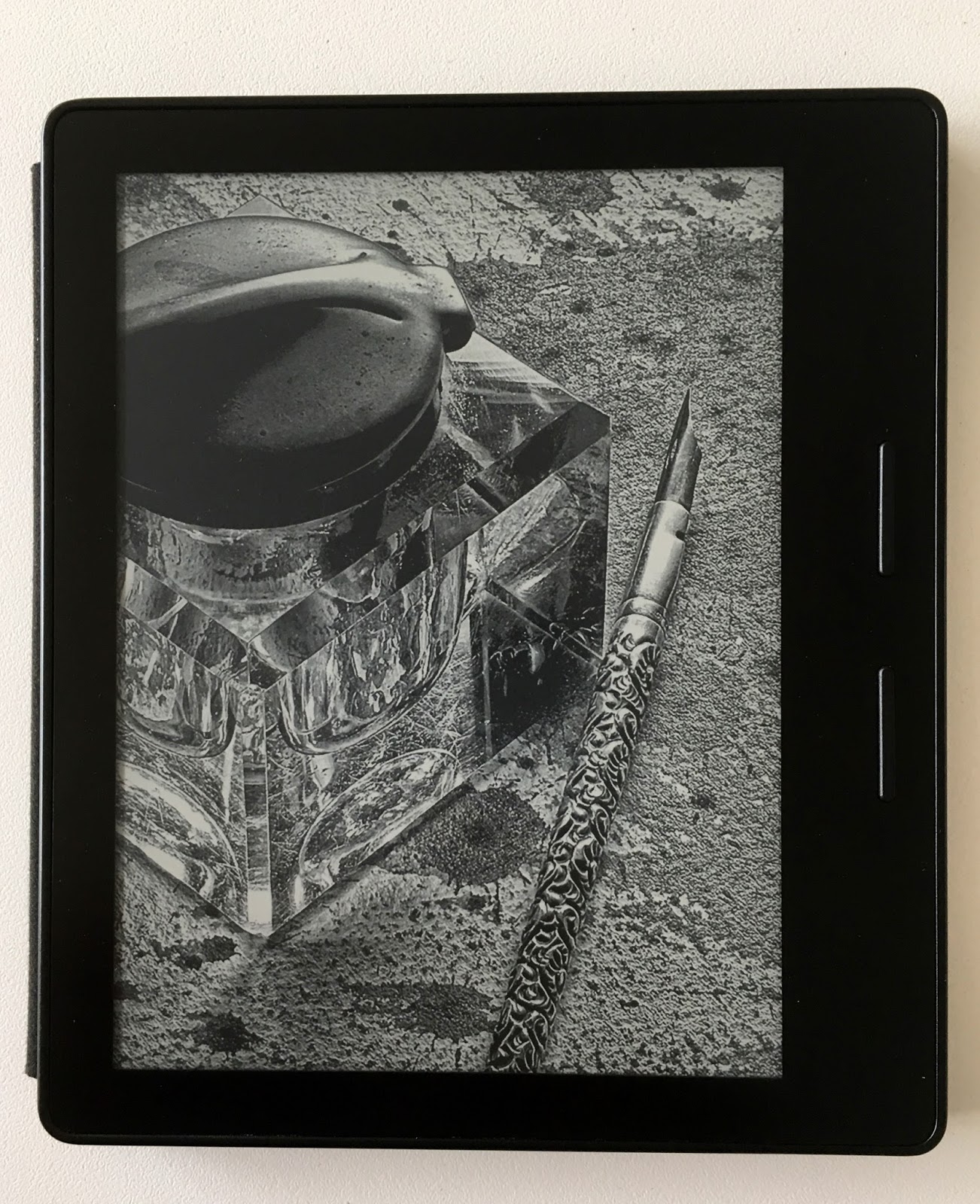
My Kindle Oasis!
I told Steve when we were starting the process to expat to Japan that he should write a letter thanking Amazon for inventing the Kindle.  Otherwise, I can't tell you how many boxes of books I would have brought with me.  I limited myself to one box (about 30 paperbacks) just in case something happened to the Kindle or the power grid (like an earthquake causes us to lose power for a week).


With my Kindle Paperwhite starting to fade a bit (taking a while to load new purchases and sometimes freezing up) I decide to purchase the Kindle Oasis.  The feature I'm most excited about is having easier access to the airplane mode button!  When it first arrives, I'm sure the screen size is smaller - but when I hold it side-by-side to my old Kindle I can see they're exactly the same.  It's just that the Oasis casing is so much smaller. 

Amazon's picture of the 1st Generation Paperwhite
This ends up being both a good and bad thing - easier for travel, but harder to read in bed.  I have to make a little pile of the sheets and blankets to raise it above my stomach, otherwise it's too painful to tilt my neck that far down.  On the Paperwhite the frame has an extra inch at the bottom, easily lifting the screen so it's level with my eyes when I lie in bed.  Nine years of Kindle, and this is my third device!  As a quick critique, it's great, but there's not enough of a difference with the Paperwhite that it's worth the price to upgrade.  However, if you use an earlier version of Kindle or your Paperwhite is starting to die, you might want to consider buying this one.

I luck out with a Daily Deal for Kindle - Amazon puts quite a few of their "Best of the Month" selections on sale, and I decide they're worth a shot (They tend to select decent novels for their "bests" - it's just the works they produce that I dislike.)   I'm glad I did!  I've read several, and they've all been worthwhile.


The first one is The Wangs vs the World by Jade Chang.   A wealthy Chinese-American family loses all their money and sets out on a road trip across the US, with all sorts of shenanigans occurring, some comic.  The narrative is told from different family members' point of view, so it's interesting to see what one character thinks of another, then get to hear their own thoughts.  A good family saga, with a little satire thrown in.


Next is Siracusa by Delia Ephron (Nora Ephron's younger sister).  I can't wait until I return home to recommend this to my book club.  Taking place in modern time, it's about two couples (and a daughter) who vacation together in the Sicilian city of Siracusa.  Told from different characters' perspectives, you're trying to figure out the "real" story - but everyone has their own biased opinion of themselves and the other members of the group.  I'd categorize this as literary fiction.


The one I was most looking forward to, The Forgetting Time by Sharon Guskin, was probably my least favorite of the three, not that it was bad.  The write up for it reminds me of Life After Life by Kate Atkinson (great novel!), but it deals with reincarnation, so it's not really similar at all.  Even if you don't have an interest in reoccurring lives, it's still an acceptable drama about a single mother raising an emotionally troubled boy.  This ends up leading her to a scientist whose lifelong study is to prove the existence of reincarnation.  


Another deal that popped up on Amazon was for All the Missing Girls by Megan Miranda.  I'd seen the good reviews for it when it was released, so I kept an eye out for it.  After I began, I was disappointed - most of it is told "in reverse" - one chapter is Day 15, the next Day 14, etc.  I feel like the movie Memento used this technique for the best purposes (I still remember the moment in watching the video when I realize we're seeing each day the same way the main character does - each time the screen goes to black you have no idea what will occur upon "waking.").  Several bestsellers have used that approach recently (Before I Sleep was also made into a movie) but I feel like it's cheap and doesn't increase the value of the plot.  However, about halfway through All the Missing Girls I start appreciating the author's manner of telling the story, and it makes it much more interesting than if it had been told in a traditional linear approach.  Definitely in the mystery/suspense genre, a woman, Nic, returns to her small hometown to help sell her father's house once he moves into a care facility.  Two girls have disappeared in the town, ten years apart, and Nic works to unravel the truth of their departures. 

I recently finished the Maise Dobbs series by Jacqueline Winspear.  After waiting patiently for another length of time until each book is discounted to $2 each, I finally have #3-12.  My local library has #1 and #2, so I borrow them before continuing on my Kindle.  This historical fiction/private investigator series takes place in the London area from pre-WWI to pre-WWII.  They're good mysteries, but I feel like you're not fully given all the clues so you a chance to figure it out yourself (I think the best mysteries are when the ending is a revelation, but then you realize the hints you missed along the way).  However, that does mean you have to reach the end to have the case solved, and you end up being surprised.  I end up buying #13 at full price because it was published a few weeks before I finished #12, so I decide I might as well get to it while I remember the fictional world in detail.  I like tales with British settings, but it's not my favorite like it is for some of my friends.  These aren't quite good enough to justify reading thirteen in a row (I wasn't devouring them, anxious to continue the narrative), but I think I was being a little lazy.  It was easier to just move on to the next one while I was familiar with all the characters and environment.

My patient stalking checking of Amazon prices gives me another triumph when many of John Scalzi's novels are reduced in price for one day.  I've been wanting to read Lock In since 2014 when it was published to great reviews.  It's satisfying, though I think I like his Red Shirts better (a tongue-in-cheek parody of Star Trek) and Agent to the Stars (literally, as in an agent for aliens).  Those stories have more comedic moments, and Lock In is a science fiction detective mystery.  As part of the same purchase I scored the Old Man's War series, which I believe is more military sci fi, and I look forward to getting to them, too.  


The Singles Game by Lauren Weisberger is a classic chick lit bestseller - a lighthearted tale regarding a single female tennis pro striving to improve her game and detailing her romantic difficulties.  Great for reading on a plane or on vacation (or on a plane on the way to vacation)!


One of my book clubs has America's First Daughter by Stephanie Dray and Laura Kamoie on its list so I decide to give it a try, even though it has the dreaded "daughter" in the title.  This is the story of Thomas Jefferson's oldest daughter, Patsy, who was involved in the background of much of his political life.  Unlike the 2300+ reviews that average 4.5 stars at Amazon, I didn't enjoy it very much...and at 624 pages, it was way too long - it could have had some better editing.  Patsy always felt like a shadow to me, without a real personality.  I learned some new facts, but it would have been faster (and maybe more pleasant) to view them on Wikipedia.


Hmm....I don't notice any non-fiction in my recent reading...I need to change that...  Here are some potential items:

You need to really focus to understand this content!
Good to read at this time of year!